

How lightning striking Apollo 12 forever changed NASA's launch weather policies
NASA now releases individual weather requirements for each space launch for optimal conditions for a safe roll-out and launch of their rockets.
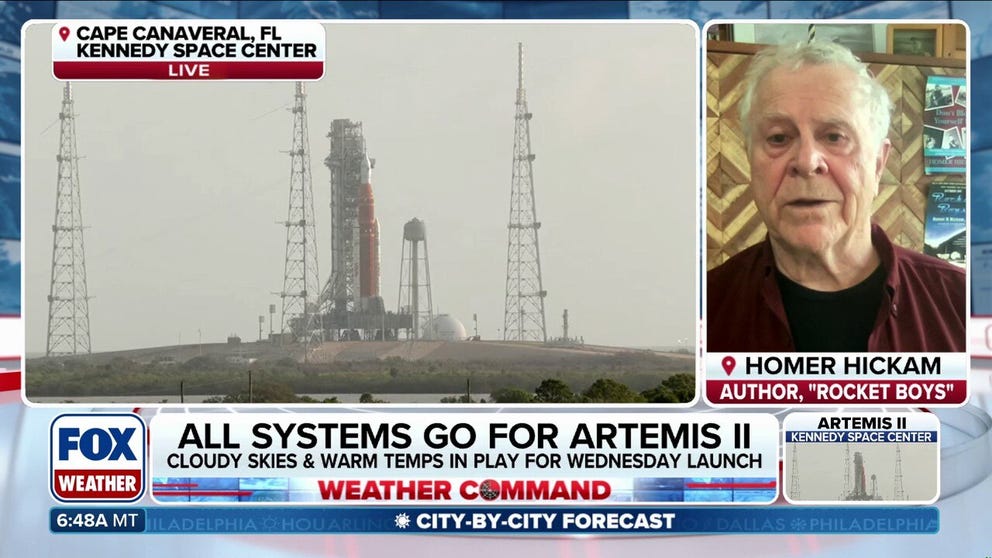
Retired NASA engineer confident weather will cooperate for Artemis II launch
The countdown is on! Retired NASA engineer Homer Hickam joins Fox Weather just one day before the Artemis II launch. In terms of weather, he’s pretty confident that it will leave the launch pad. Are you as excited as we are for this historic launch? Stick with FOX Weather for the latest.
When Apollo 12, NASA's second lunar landing mission, launched from Kennedy Space Center, the space vehicle was struck by lightning— twice.
On Nov. 14, 1969, Apollo 12 prepared to bring three astronauts into space, landing on the Moon for the second time ever on a cloudy, rainy day.
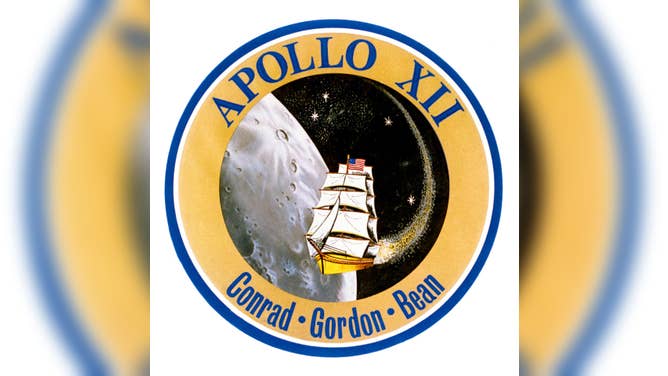
This is the official crew insignia for Apollo 12, the United States' second lunar landing mission
(NASA)
NASA had recognized lightning during thunderstorms to be a problem for spaceflight during its early days, so the agency never allowed launch during thunderstorms.
However, what they didn't realize at the time, was that a rocket launching into space could trigger lightning if it flew through highly electrified clouds.
What happened to Apollo 12?
A southward-moving cold front was passing through central Florida, producing cloudy skies and rain showers as launch time for Apollo 12 approached, NASA said.
NASA said, although no lightning was reported in the area before the launch, potential gradient measurements from sensors were varying significantly, implying rapidly and highly fluctuating electric fields over the launch area before the final countdown.
NASA'S ARTEMIS MISSIONS: EVERYTHING YOU NEED TO KNOW AHEAD OF THE HISTORIC MOON LAUNCH
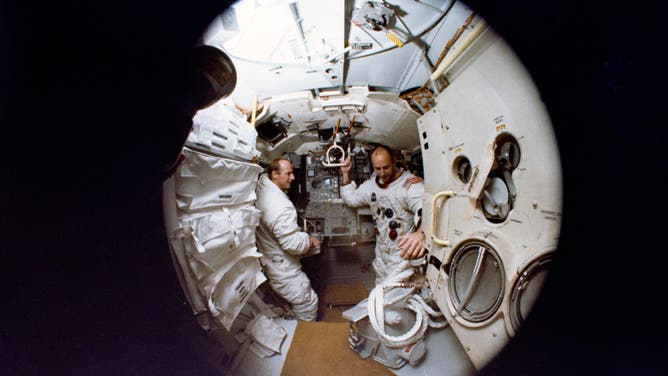
(22 Oct. 1969) --- A fish-eye lens view of astronauts Charles Conrad Jr. (on left), Apollo 12 commander, and Alan L. Bean, lunar module pilot, inside the Apollo Lunar Module Mission Simulator during simulator training at the Kennedy Space Center (KSC).
(NASA)
Because there was no lightning, not violating any rules of the Lightning Launch Commit Criteria, and President Nixon was in attendance, mission control didn't want to delay the launch.
So, Apollo 12 launched as planned, and 36 seconds later, the rocket was hit by lightning, which disconnected the service module’s fuel cells that produced power for the command module, NASA said.
10 IMPORTANT ROCKET LAUNCHES IN THE HISTORY OF THE US SPACEFLIGHT
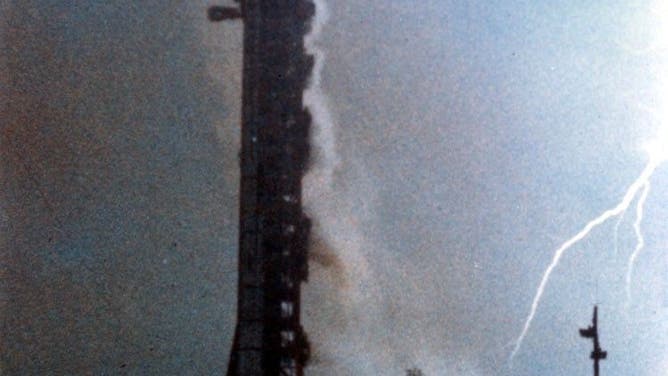
Nov. 14, 1969: View of a lightning bolt during the launch of Apollo 12 from Pad A, Launch Complex 39, Kennedy Space Center. The silhouetted structure is the mobile launch tower.
(NASA)
Sixteen seconds later, Saturn V was hit by another bolt of lightning. NASA said this strike impacted the command module's navigation system, causing temporary loss of the system’s stabilizing platform and denial of critical flight data to Mission Control.
The recommendation of a young NASA engineer resulted in flight telemetry being restored. Fortunately, the Saturn V booster’s systems, including navigation and communications, had not been affected by the lightning strikes, NASA said.
SOLAR FLARE EVENT HAPPENS DAYS BEFORE ARTEMIS II MISSION. NASA SAID THEY'RE NOT CONCERNED ABOUT IT
Apollo 12 was able to continue its launch into space and conduct its mission without further problems, safely splashing down in the Pacific Ocean 10 days later on Nov. 24, 1969.
Change in weather launch policies
The incident led to a lot of lightning research among the aerospace community, NASA said.
After careful consideration, NASA implemented a new Lightning Launch Commit Criteria a few months later, to significantly lower the risk of being struck by lightning again.
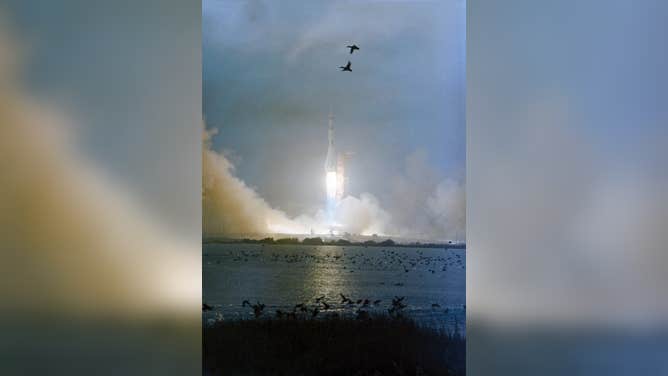
The huge, 363-feet tall Apollo 12 space vehicle is launched from Pad A, Launch Complex 39, Kennedy Space Center (KSC), at 11:22 a.m. (EST), Nov. 14, 1969. Aboard the Apollo 12 spacecraft were astronauts Charles Conrad Jr., commander; Richard F. Gordon Jr., command module pilot; and Alan L. Bean, lunar module pilot.
(NASA)
Over the years, further research and technology advancements allowed for the LLCC to be revised, updated and improved to increase both launch availability and launch safety, NASA said.
NASA now releases individual weather requirements for each space launch for optimal conditions for a safe roll-out and launch of their rockets.
For example, Artemis II, NASA's first crewed lunar flyby mission for the Artemis program, has a planned launch date on April 1.
MEET THE ASTRONAUTS PREPARING FOR HUMANITY’S RETURN TO THE MOON ON THE ARTEMIS II MISSION
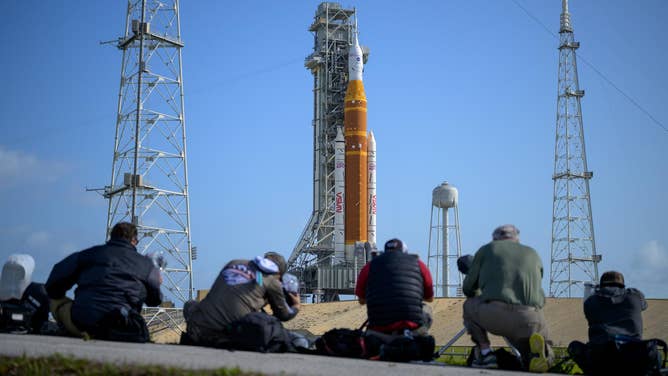
Media aim their remote cameras on NASA’s Artemis II Space Launch System (SLS) rocket and Orion spacecraft, atop a mobile launcher at Launch Complex 39B, Sunday, March 29, 2026, at NASA’s Kennedy Space Center in Florida.
(NASA/Bill Ingalls / NASA)
The Orion spacecraft and SLS rocket cannot launch if temperatures aren't between 41° and 94°, winds are higher than 33–44 mph and if there is rain, thunderstorms, lightning, certain clouds or solar activity.
The near-disaster of lightning striking Apollo 12 changed the future of aerospace launches forever.