

8-year-old girl dies from suspected brain-eating amoeba in Louisiana
The young girl's family said 8-year-old Lillian Smart suffered injuries to her brain that were too severe for her body to recover from.

FILE: New test for brain-eating amoeba
Eight years after their son died from a brain-eating amoeba, the Smelskis are relieved to help announce a new test in their home state. FOX 35 Orlando explains.
THE TAKEAWAY
- An eight-year-old girl has died after contracting a brain-eating amoeba in Louisiana.
- The young girl was hospitalized with Naegleria fowleri.
- Nearly everyone who contracts this infection dies.
BATON ROUGE, Louisiana – Tragedy has unfolded in Louisiana where an 8-year-old has passed away after contracting a suspected brain-eating amoeba.
Officials from the Louisiana Department of Health (LDH) are urging residents in the area to avoid visiting Henderson Lake, where a cyanobacterium, or a blue-green algae bloom, has been observed.
Officials initially announced on Wednesday that an unidentified victim had become hospitalized with Naegleria fowleri and was receiving care at Ruston Hospital.
TOXIC ALGAE DETECTED AT COLORADO'S LARGEST RESERVOIR AS OFFICIALS WARN VISITORS OF HEALTH RISKS
The young girl's family said 8-year-old Lillian Smart suffered injuries to her brain that were too severe for her body to recover from.
In a public Facebook group called "Love for Lillian," the family said: Everyone did everything they could to keep her here. We are heartbroken and honestly do not know what to do next. How do we put one foot in front of the other without our girl?"
"Our foundation is still in Jesus. We didn’t get to keep our girl, but we watched miracles happen on her behalf. We believe God is good. He will give us strength when we have none left," the group said in a Facebook post.
The CDC said it is a free-living amoeba that thrives in warm freshwater lakes, rivers and hot springs.
STUDY FINDS FLESH-EATING BACTERIA, HARMFUL ALGAL BLOOMS IN LONG ISLAND WATERS AS QUALITY WORSENS
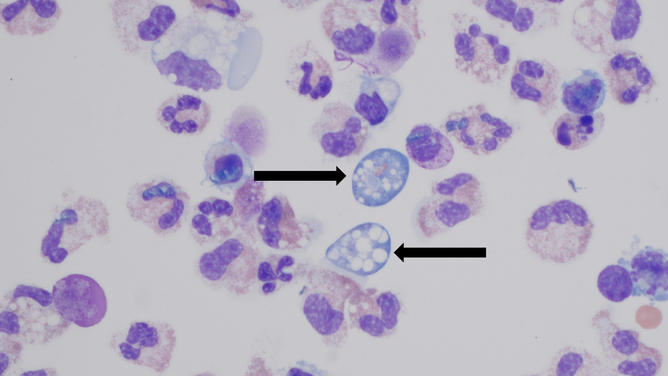
Naegleria fowleri infects people by traveling up the nose and to the brain.
( Dr. James Roberts, Children’s Healthcare of Atlanta)
"If water containing the amoeba goes up the nose and to the brain, it can cause an infection called primary amebic meningoencephalitis," the CDC warned.
Nearly everyone who gets this infection dies.
HIDDEN HAZARD: HOW TO STAY SAFE FROM HARMFUL ALGAL BLOOMS THIS SUMMER
Health officials identified and confirmed the presence of cyanobacteria using satellite imagery.
Most people think algae are harmless, but certain types of cyanobacteria can produce toxins that harm people and animals.
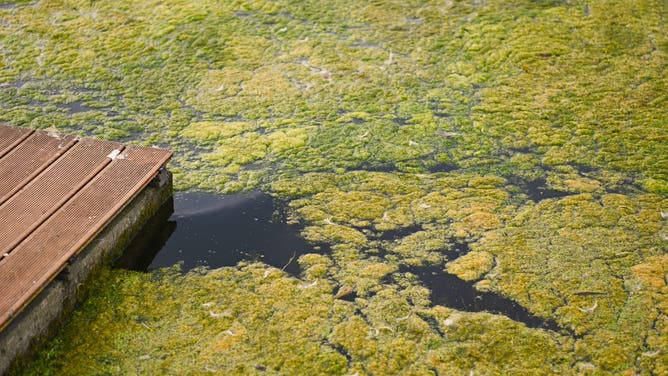
29 August 2019, Bavaria, Breitengüßbach: Algae swim on the water surface of the dredging lake of Breitengüßbach. The Breitengüßbach dredging lake is one of several lakes where water pollution such as blue-green algae has occurred due to the heat and has therefore been closed to bathing.
(Nicolas Armer/picture alliance / Getty Images)
"Because algal blooms can move and change quickly, LDH recommends avoiding areas where a bloom is visible or suspected," the health department said. "You cannot tell whether a bloom is producing toxins just by looking at it."
Unfortunately, it can be easy to mistake these bodies of water for a safe swim.
BRAIN-EATING AMOEBA DETECTED IN WATER AT ICONIC US NATIONAL PARKS, STUDY FINDS
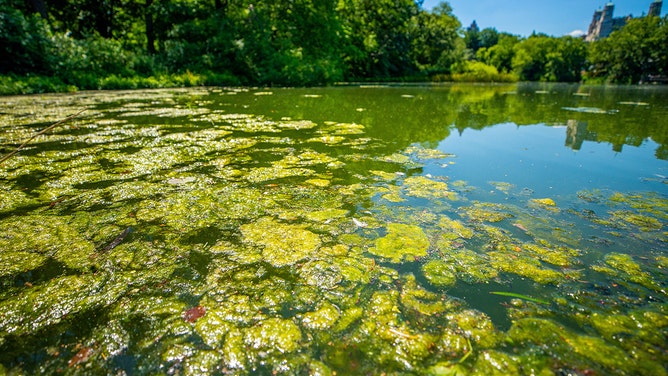
Increasing global temperatures, a rise in pollution, and a build-up of nutrients in run-off water lead to the excess growth and prevalence of harmful algal blooms in the Park’s water bodies.
(Central Park Conservancy)
CHILD DIES FROM SUSPECTED 'BRAIN-EATING AMOEBA' AFTER SWIMMING IN NEBRASKA RIVER
What to do if you see or smell an algae bloom
- Stay out of affected water. Avoid swimming, wading, boating or other recreational activities in areas with an active bloom.
- Keep pets away. Do not allow pets to swim in or drink water where a bloom is present.
- Wash after contact. If you or your pet comes into contact with affected water, promptly wash with soap and clean water.
- Do not drink or cook with affected water. Do not use water from an area experiencing an algal bloom for drinking, cooking or preparing food.
- Watch for symptoms. Exposure to harmful algal toxins can cause rashes, stomach cramps, coughing, nausea, diarrhea or vomiting. High levels of exposure can affect the liver and nervous system. Contact a healthcare provider if you develop symptoms after exposure.