

Arctic blast overspreads the Midwest and Great Lakes after monster blizzard slams millions
Snow squalls and lake-effect snow moved in Tuesday as preliminary 24-hour snowfall records may have been broken in Wisconsin and Michigan.
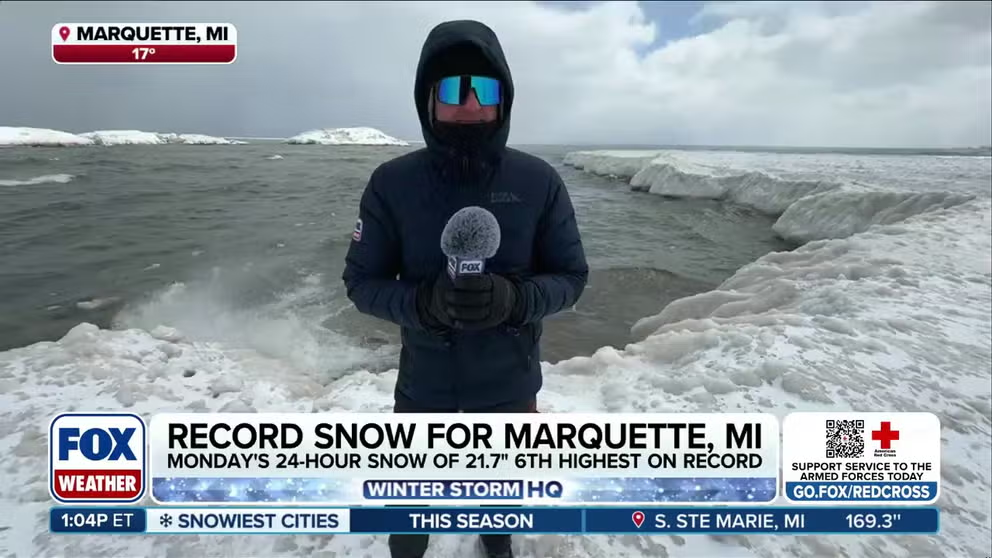
Lake Superior shoreline coated in ice following historic blizzard in Michigan
Marquette, Michigan received more than 3 feet of snow during a historic blizzard Sunday and Monday. Lake Superior's waves were massive, crashing up onto the shorelines and coating everything in a thick layer of ice. FOX Weather Correspondent Robert Ray shows us how things are looking today and details some of the magnificent formations of ice on the shores.
A life-threatening situation unfolded as a monstrous blizzard unleashed feet of snow and vicious wind gusts throughout the Upper Midwest and Great Lakes.
More than 75,000 Michigan residents remain without power. At one point, that number topped 110,000.
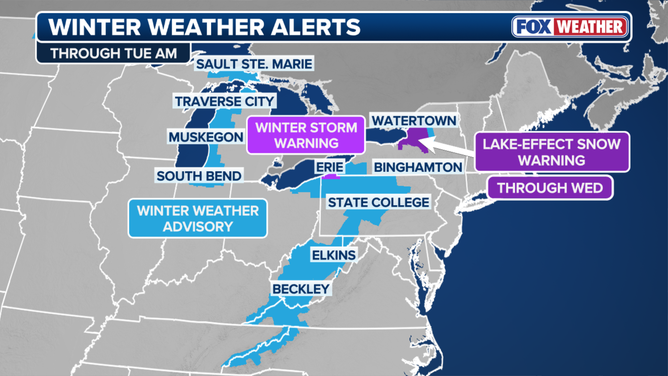
Winter Weather Alerts through Tuesday morning.
(FOX Weather / FOX Weather)
After blizzard warnings tapered off Tuesday morning, snow squalls and lake-effect snow lingered as temperatures plummeted.
The FOX Forecast Center explained that while the lakes still have partial ice cover, the sharp drop in low-level temperatures created steep lapse rates.
BITTER ARCTIC COLD BLAST TO IMPACT OVER 200 MILLION AMERICANS IMMEDIATELY AFTER MONSTROUS BLIZZARD
Combined with saturated air in the main snow-producing layer, this set the stage for intense snow bands to form.
These snow bands were heaviest in the favored snow belts east of Lakes Erie and Ontario, as snowfall rates reached 1 inch per hour.
In Michigan, building high pressure from the west gradually eased winds, but its clockwise circulation drew air across Lakes Superior and Michigan, producing periods of heavy snow that tapered off Tuesday evening.
![]() Image 1 of 7
Image 1 of 7Snow falling in Marquette, Michigan, on Sunday, March 15, 2026. (Robert Ray)
![]() Image 2 of 7
Image 2 of 7Snow falling in Marquette, Michigan, on Sunday, March 15, 2026. (Robert Ray)
![]() Image 3 of 7
Image 3 of 7Snow falling in Marquette, Michigan, on Sunday, March 15, 2026. (Robert Ray)
![]() Image 4 of 7
Image 4 of 7Snow falling in Marquette, Michigan, on Sunday, March 15, 2026. (Robert Ray)
![]() Image 5 of 7
Image 5 of 7Snow falling in Marquette, Michigan, on Sunday, March 15, 2026. (Robert Ray)
![SPRING, TEXAS - JANUARY 21: Road crews spray a brine solution along I-45 north bound near Loretta Rd. Tuesday, Jan. 21, 2025, in Spring. (Melissa Phillip/Houston Chronicle via Getty Images)]() Image 6 of 7
Image 6 of 7FILE - SPRING, TEXAS - JANUARY 21: Road crews spray a brine solution along I-45 north bound near Loretta Rd. Tuesday, Jan. 21, 2025, in Spring. (Melissa Phillip/Houston Chronicle via Getty Images) ((Melissa Phillip/Houston Chronicle via Getty Images))
![FILE: Northbound traffic on I-95 is at a standstill following a tractor trailer that jack-knived in the snowstorm.]() Image 7 of 7
Image 7 of 7FILE: Northbound traffic on I-95 is at a standstill following a tractor trailer that jack-knived in the snowstorm. ( Jill Brady / Portland Press Herald)
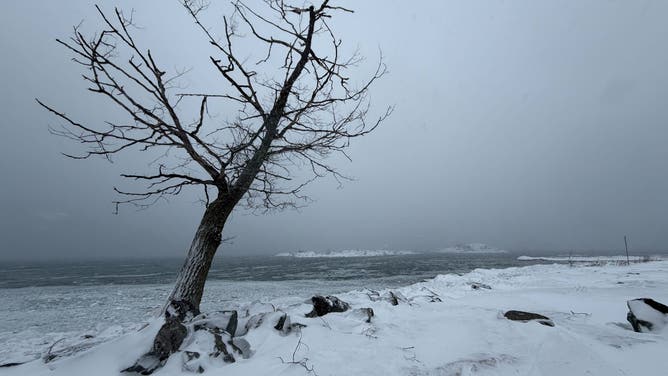
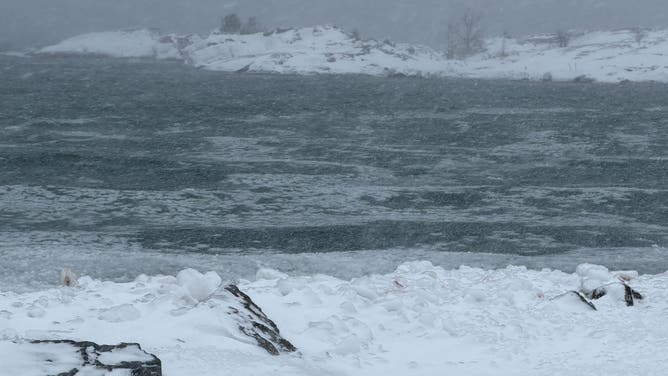
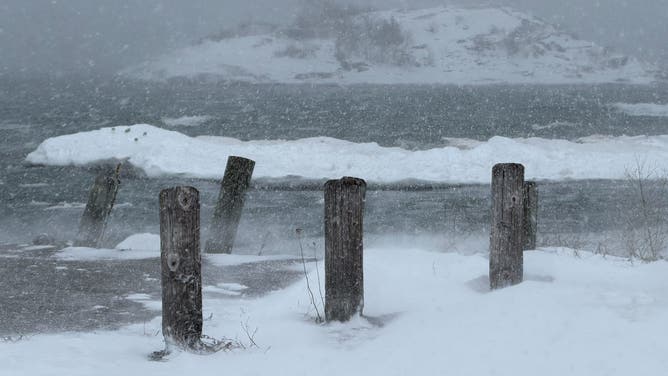
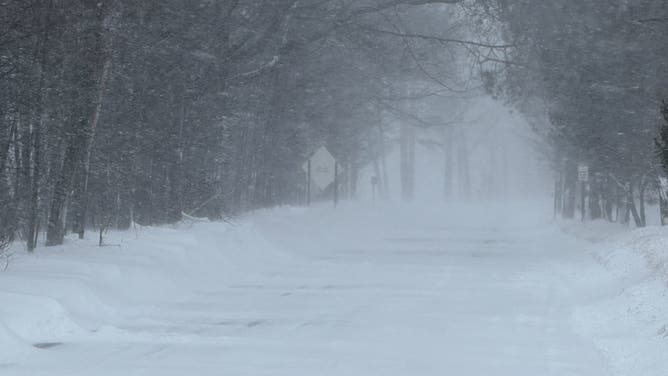
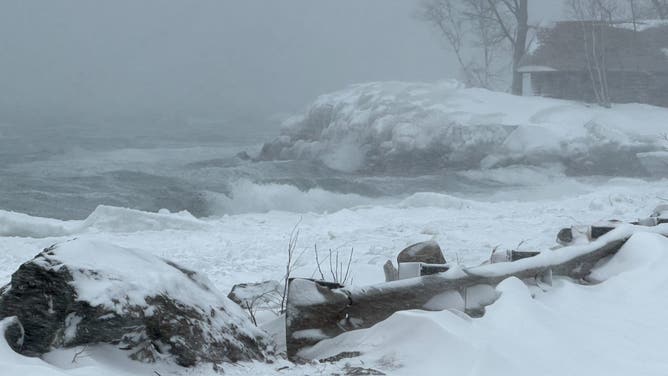
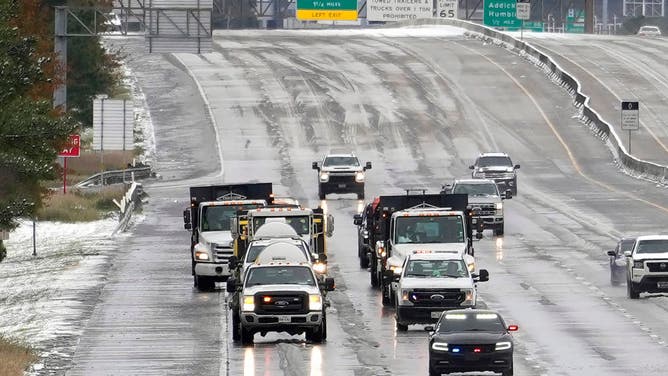
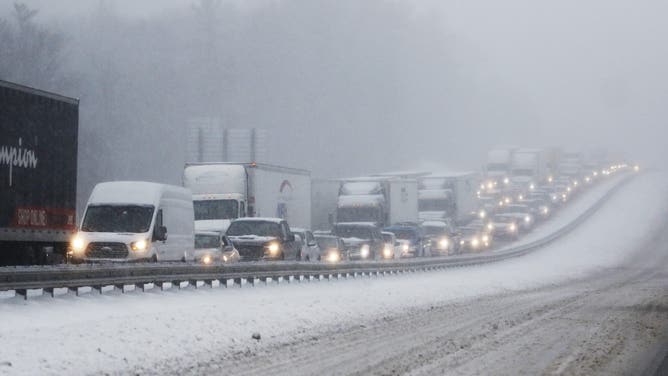
Over the weekend, snow started across portions of the Northern Tier and then charged east into the Great Lakes, with preliminary 24-hour snowfall records possibly broken in Wisconsin and Michigan.
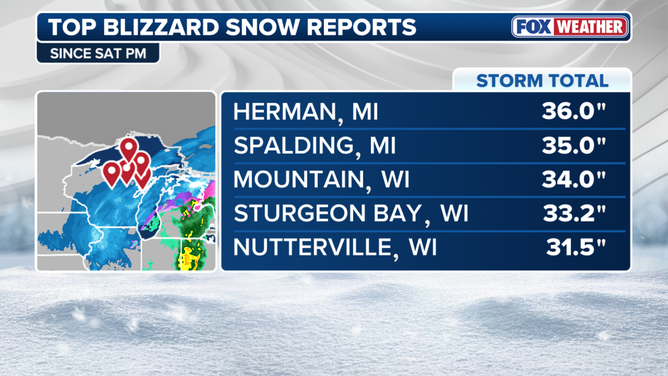
Top blizzard snow reports since Saturday evening
(FOX Weather / FOX Weather)
Specifically, Herman, Michigan, received a staggering 3 feet of snow, while Marquette’s 34.5-inch storm total breaks the all-time two-day snowfall record of 31.9 inches set on March 13 to 14, 1997.
GREEN BAY, WISCONSIN SEES BIGGEST SNOWFALL IN OVER A CENTURY
While Blizzard Warnings were issued across southern Minnesota, Iowa, northwestern Illinois, most of Wisconsin—including Milwaukee and Green Bay—and parts of northern Michigan and the Upper Peninsula, they were officially verified only in Green Bay and Marquette.
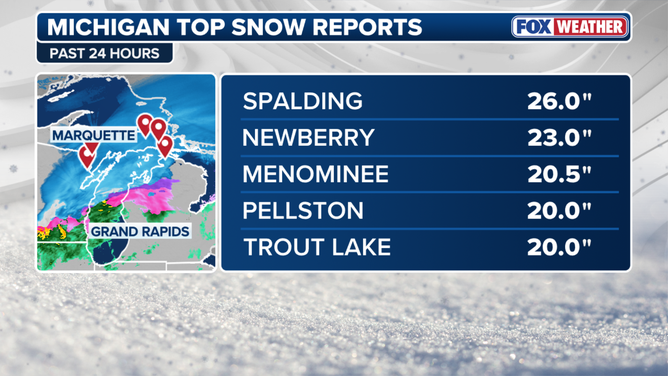
Michigan's top snow reports within the past 24 hours
(FOX Weather / FOX Weather)
The FOX Forecast Center said many other weather stations came close but did not meet the criteria.
Parts of Northern Michigan were also under an Ice Storm Warning through most of Monday morning, with over 0.25 inches of accretion reported in Northern Michigan.
WHAT IS BOMBOGENESIS AND WHAT DOES IT MEAN WHEN A STORM ‘BOMBS’ OUT?
This was Milwaukee's first Blizzard Warning in 15 years and Milwaukee County declared a Snow Emergency, closing all non-essential county facilities.
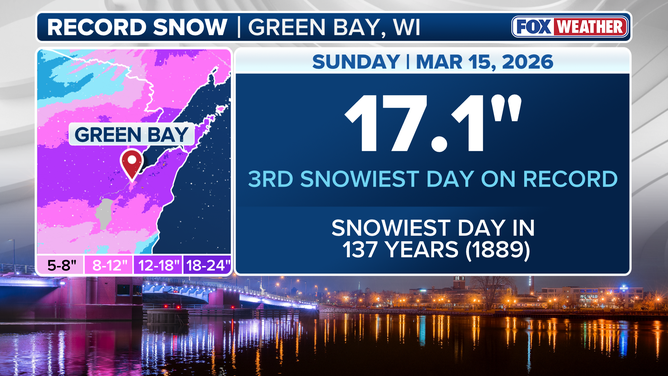
Record snow in Green Bay, WI.
(FOX Weather / FOX Weather)
More than 2 feet of snow has fallen across Wisconsin and Michigan since Sunday, with historic totals in Green Bay, while parts of Minnesota saw nearly 2 feet.
There were widespread, life-threatening travel conditions across the region during the storm.
WINTER STORM WARNING EXPLAINED: WHAT DOES IT MEAN AND WHEN IS IT ISSUED?
Air travel ground to a halt across major Midwest hubs, with thousands of flight disruptions reported across the country.
U.S. Secretary of Transportation Sean Duffy took to X on Monday, highlighting nationwide flight disruptions from the storm: "At least 2,000 flights canceled, more than 9,500 delayed."
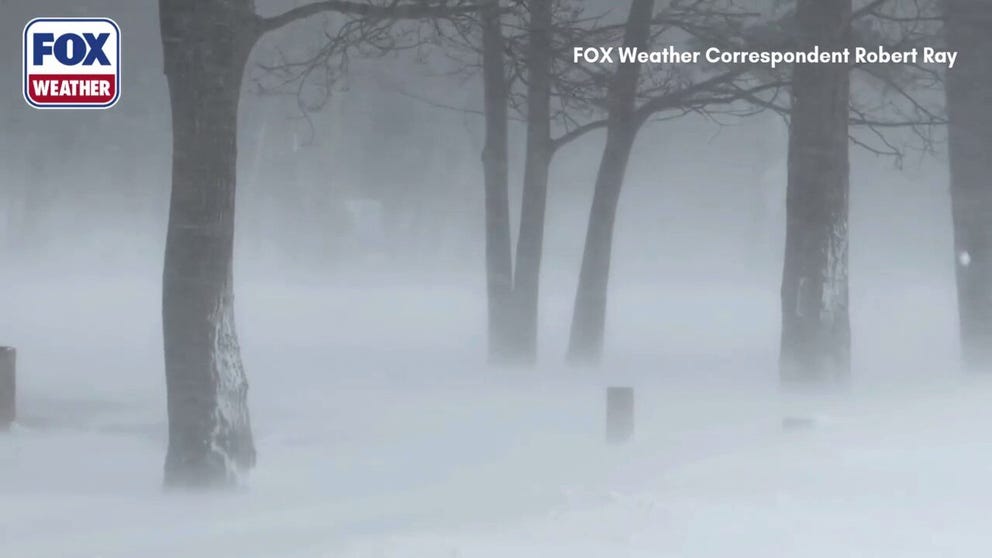
Watch: Vicious wind gusts, blinding snow slam Marquette, Michigan
FOX Weather Correspondent Robert Ray captured this video of howling wind gusts and blinding snow that slammed Marquette, Michigan Sunday.
This comes just days after a major windstorm blew through Chicago, Minneapolis and Milwaukee.
Michigan Gov. Gretchen Whitmer reactivated the state's Emergency Operations Center a little more than a week after a severe weather outbreak, including deadly tornadoes that tore through Three Rivers.
WHAT YOU SHOULD KNOW ABOUT BLOWING, DRIFTING SNOW
Blizzard conditions were verified in Green Bay, Wisconsin, on Sunday night, and the city picked up a total of 26.1 inches of snow during the blizzard, with 17.1 inches falling Sunday alone — its most snow in one day since Jan. 1, 1889.
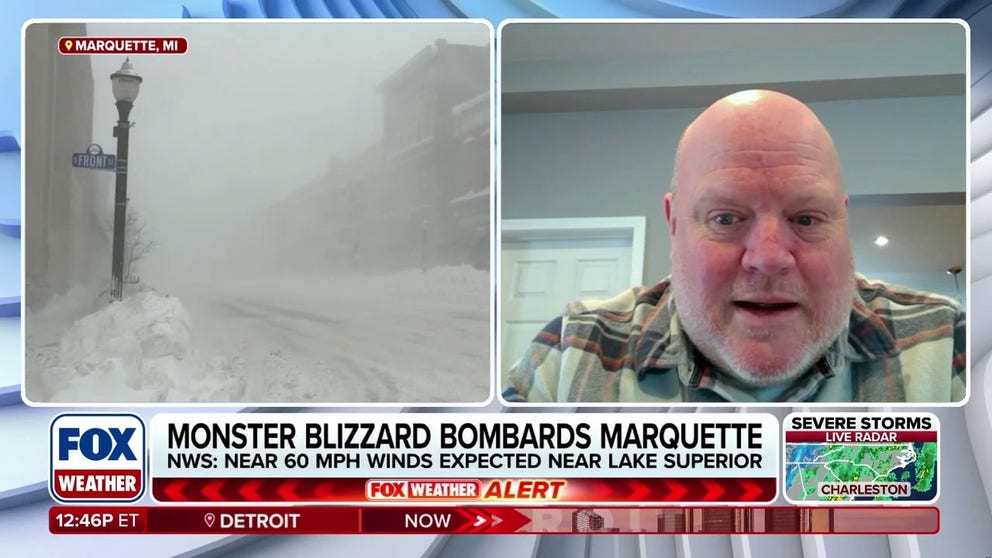
Mayor of hard-hit Michigan city talks about ongoing blizzard
Paul Schloegel, commissioner and mayor of the City of Marquette, joins FOX Weather to discuss the monster blizzard bombarding the city with feet of snow.
With the Ice Storm Warning issued for northern Michigan, Grayling recorded 0.28 inches of ice—enough to bring down trees and power lines.
HOW MUCH ICE IS NEEDED TO KNOCK OUT POWER, DAMAGE TREES?
The center of the storm slowly moved into southeastern Canada through the day, and blizzard conditions gradually lifted.
Cold winds out of the Northwest quickly moved in and triggered intense lake-effect snow across the Upper Peninsula and the shores of Northern Michigan.
Additionally, high winds produced up to 20-foot waves along Lake Superior. Waves that high can cause beach erosion and lakeshore flooding.
Dangerous cold air moves in
Behind the system, colder air settles in, meaning the vast majority of snow that falls will likely remain on the ground for at least several days.
Cold air surges back into the Plains and Midwest, sending afternoon highs of 15 to 25 degrees below average from the Canadian border all the way to the Texas–Mexico border.
Highs will struggle to reach the teens and 20s in the Midwest, with 40s and 50s across the Mid-South.

(FOX Weather)
Bitter wind chills dropped into the negative single digits and teens in cities like Minneapolis and Green Bay, while places such as Oklahoma City and Atlanta saw wind chills in the teens and 20s on Tuesday.
A few record lows are possible across parts of the Deep South.
Recovery efforts are expected to be slow as crews tackle massive snow drifts and sub-zero temperatures.
Unfortunately, residents without power will face increased risks in the coming days due to the plunging temperatures and lingering snow hazards.
Another round of light snow will move into the region Tuesday night into Wednesday night.